

Editor’s note
I have to admit, typing #10 into this title felt good. After a few weeks of series, webinars and worthwhile detours, we’re back to our usual issues. I hadn’t realised how much I’d missed seeing the issue number in its usual place.
This week’s issue began with a framework survey from a Packt book on financial agents. But as I worked through it, the comparison felt useful beyond finance. The same decisions (how much orchestration you need, where your data lives, how outputs are validated, and how much control you are willing to hand to a platform) appear in almost every agent project.
So I’ve condensed the survey into a practical map of ten frameworks.
The aim is not to leave you knowing all ten frameworks inside out. It is to help you narrow the field and understand which trade-offs matter for your work. Start with the frameworks already on your shortlist, then use the comparisons to see what each would give you—and what your team would have to maintain.
Before we compare the frameworks, a quick word from PlayerZero. The frameworks we discuss in this issue shape how agents are built and orchestrated. But PlayerZero addresses another part of the stack, giving those agents a shared, current view of your code, tickets, and telemetry.
Before you add another agent, give them all the same context

PlayerZero is the AI orchestration and context platform for engineering teams
Code isn’t the bottleneck anymore. Context and review are. Every agent your team adds starts from its own partial picture, and your senior engineers end up filling the gaps by hand.
PlayerZero builds one engineering world model from your code, tickets, and telemetry, then orchestrates agents across product, engineering, QA, support, and SRE on top of it. Work moves between teams with full context attached. When an agent reaches the edge of what it should decide, it pulls in the right person with the investigation already done. That decision goes back into the model, so the next agent inherits it.
Key Data doubled its release velocity. Cayuse catches 90% of issues before production.
LangChain/LangGraph: Modular orchestration and RAG
LangChain is arguably the most widely adopted open-source framework for building LLM-powered applications. It provides modular abstractions for prompts, tools, memory and chains of reasoning. Over time, it has grown into an ecosystem that supports RAG, tool integration and multi-agent orchestration.
LangGraph, a companion project, extends LangChain by introducing graph-based agent workflows. Instead of linear prompt chains, LangGraph allows for branching, looping and controlled execution graphs, making it a highly customisable and powerful way to design complex agent systems.
Strengths: Combines broad tool and data integrations with RAG and flexible graph-based orchestration. It supports branching, persistent state and human approval points for complex workflows.
Limitations: Its flexibility brings complexity, performance overhead and a steep learning curve. Enterprise observability, compliance and deployment require additional tooling, while fast API changes can leave older guidance behind.
Google ADK
The Google Agent Development Kit is Google’s framework for developing and deploying AI agents. It is optimised for its managed Agent Engine runtime and the Gemini family of models, but designed to be model-agnostic. Unlike lightweight open-source tools or experimental research frameworks, ADK is positioned as an enterprise-grade platform for organisations that need production-scale agent systems with security controls.
Strengths: Combines reasoning agents, deterministic workflows and custom Python logic within a graph-based runtime. Native Google Cloud integration adds enterprise scaling, monitoring and access controls.
Limitations: ADK is powerful but heavyweight, with a smaller community ecosystem and considerable infrastructural lock-in once workflows depend on Google Cloud services.
CrewAI: Role-based multi-agent collaboration
CrewAI is an open-source Python framework designed for building teams of collaborating agents. Unlike frameworks that emphasise orchestration pipelines, CrewAI is built around the metaphor of a crew of specialists working towards a common goal.
Each agent has a role, a goal, a backstory that defines how it behaves and access to tools such as APIs, code execution and retrieval functions.
Strengths: Organises agents around recognisable roles, goals and delegation patterns. It supports sequential, parallel and hybrid workflows that resemble committees or specialist teams.
Limitations: The open-source core requires additional tooling for production observability, validation and governance, and may struggle at enterprise scale.
AutoGen: Conversational orchestration
AutoGen, developed by Microsoft, is an open-source framework designed for multi-agent conversational systems. Its core philosophy is that agents should interact through dialogue, both with one another and with humans, to solve complex tasks collaboratively.
Instead of hard-coded pipelines, AutoGen uses natural-language conversations as the control mechanism. Agents communicate through messages, text or function calls, making workflows more flexible and interpretable.
Strengths: Coordinates specialist agents through recorded conversations, with support for tools, code execution and human participation. This makes collaborative reasoning transparent and easier to inspect.
Limitations: Conversational orchestration can be verbose, slow and expensive to scale. AutoGen is also now in maintenance mode, with Microsoft directing new projects towards Microsoft Agent Framework.
OpenAI Agents SDK
The OpenAI Agents SDK is OpenAI’s production-ready framework for building agent-based systems. Unlike experimental frameworks or open-source prototypes, the SDK is designed for enterprise deployment.
Strengths: Provides handoffs, session memory, parallel guardrails, hosted tools and built-in tracing. These production controls make multi-agent workflows easier to operate and audit.
Limitations: Its strongest tracing and hosted-tool capabilities remain tied to OpenAI, while the framework offers less freedom than LangGraph and may become expensive at scale.
PydanticAI: Type-safe agents for structured data
PydanticAI—stable at 1.0 since September 2025, with a substantially redesigned 2.0 released in June 2026—comes from the creators of Pydantic, the widely used Python library for data validation. It brings strict typing, schema validation and reliable structured outputs into the world of AI agents.
Strengths: Enforces typed schemas, validates model outputs and retries malformed responses automatically. It integrates easily with Python APIs, data pipelines and larger orchestration frameworks.
Limitations: PydanticAI validates output structure, not the quality of the model’s reasoning, and still needs another framework for complex orchestration.
Mistral AI agents: Lightweight, open-weight performance
The philosophy behind Mistral’s agent framework is deliberately lean and open-weight-first, in contrast to enterprise-heavy offerings such as Google ADK or the OpenAI Agents SDK. It aims to give developers fast, cost-effective and flexible agent infrastructure without vendor lock-in.
Strengths: Offers efficient open-weight models alongside hosted agents with retrieval, code execution, memory and handoffs. Local deployment supports cost control and data sovereignty.
Limitations: Its agent ecosystem is younger and offers fewer built-in governance and observability features, often leaving orchestration to third-party frameworks. Smaller models may also sacrifice reasoning quality for speed.
smolagents: Minimalist code-first agents
smolagents is Hugging Face’s lightweight, code-first agent framework, designed around a simple philosophy: agents should write and execute code to solve tasks. Unlike orchestration-heavy frameworks or enterprise platforms, smolagents makes every agent step a readable, runnable Python snippet.
Strengths: Uses visible, executable Python as the agent’s primary way of solving tasks. Its lightweight, model-agnostic design makes agent behaviour easier to understand and prototype.
Limitations: Designed primarily for learning and prototyping, it has basic orchestration, fewer integrations and limited enterprise governance. Any production use involving generated code requires careful sandboxing.
Claude Agent SDK: Safe-by-design agentic workflows
Claude, Anthropic’s family of models, is widely recognised for its safety-first design philosophy. The Claude Agent SDK—renamed from the Claude Code SDK in September 2025—is the agent harness that powers Claude Code: a production-hardened loop for gathering context, taking action and verifying results, exposed so developers can build their own agents on the same engine.
Strengths: Combines sessions, subagents, hooks, Agent Skills and MCP connectivity with safety-oriented controls. Computer Use extends automation to systems that lack APIs.
Limitations: It offers less orchestration flexibility than LangGraph or CrewAI and is tied to Claude models. Its community focuses more on MCP and Skills than on orchestration recipes.
LlamaIndex: Data-centric agents
LlamaIndex began as GPT Index, a framework for connecting large language models to external data sources. While best known for its RAG capabilities, it has since evolved into a data-centric agent framework with support for multiple agent types, introspection and orchestration.
Strengths: Grounds agents in documents, databases, APIs and knowledge graphs. Its retrieval-focused agents, memory and event-driven workflows make it a strong data layer for data-heavy applications.
Limitations: LlamaIndex is stronger at data grounding than orchestration and requires additional tooling for enterprise observability. Advanced capabilities such as knowledge graphs also demand more setup.
If you’re weighing these options for a real project, I hope the view below makes the trade-offs a little easier to hold in your head.
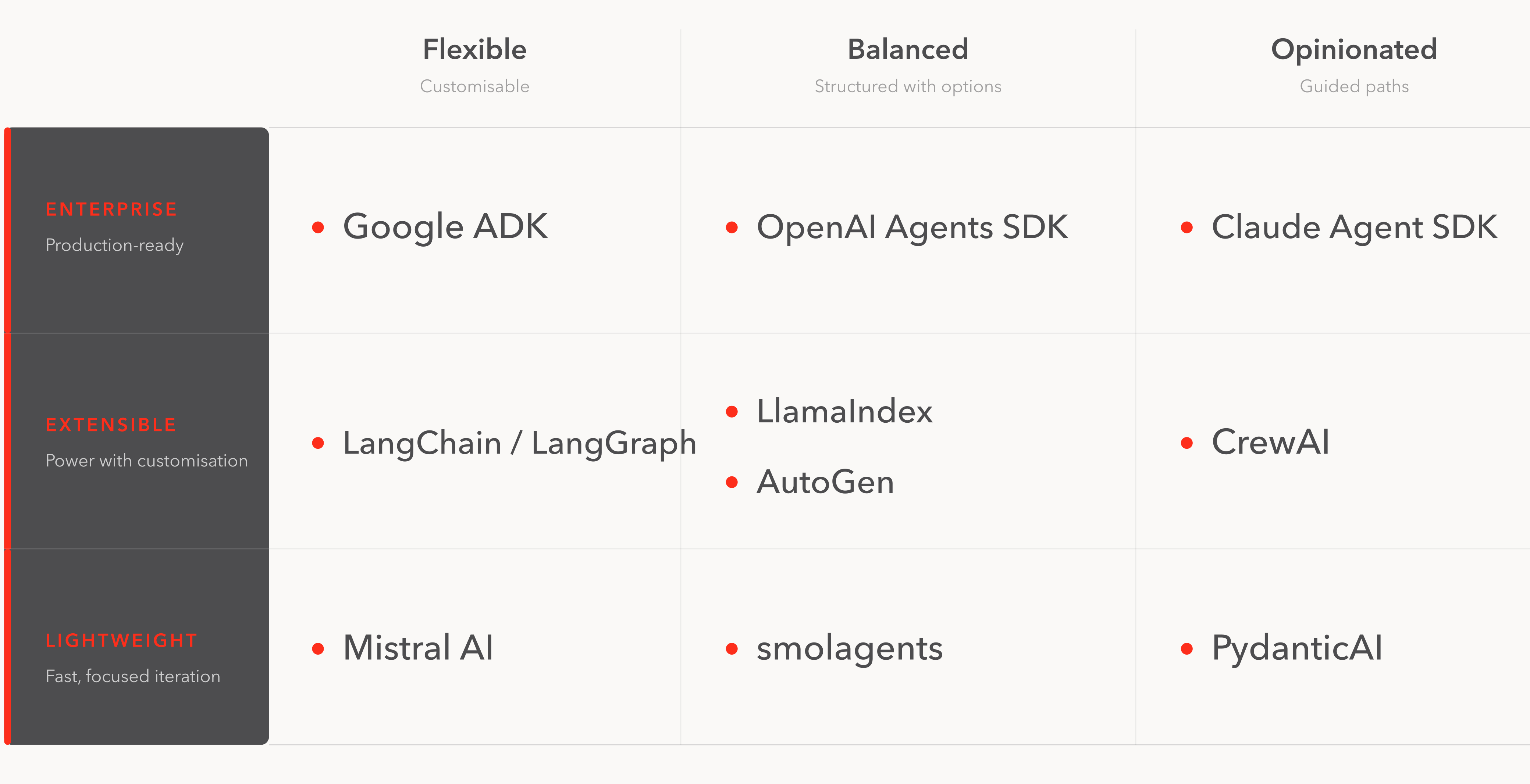
That’s it for this one. We’ll pick up the conversation next week.
Until then, keep building.
Tanya D’cruz
Editor-in-Chief