

Editor’s note
Earlier this week, Prasanna and I talked about why a complete agent trace is not necessarily a complete explanation. But there is an even slipperier problem. Sometimes the trace looks clean because the system does not think it failed at all.
Kanishk Patel calls this silent success. The agent finishes, answers confidently and gets counted as successful even though it never delivers everything the user asked for. It felt like the right piece to publish next because it pushes the podcast’s question into the harness itself. If a clean run cannot prove that the outcome happened, what should we count as success?
Kanishk is a Forward Deployed Engineer on the Agentic Solutions team at Kinaxis, where he builds multi-agent systems, RAG and evaluation pipelines with enterprise customers. Previously, as co-founder and CTO of BinoLoop, he built a multi-agent platform for the U.S. Army Contracting Command that helped reduce procurement cycles from eight months to 30 days. He also writes Learn Agentic AI, where he breaks down new agent research for builders every day.
The worst bug I’ve shipped didn’t throw an error.
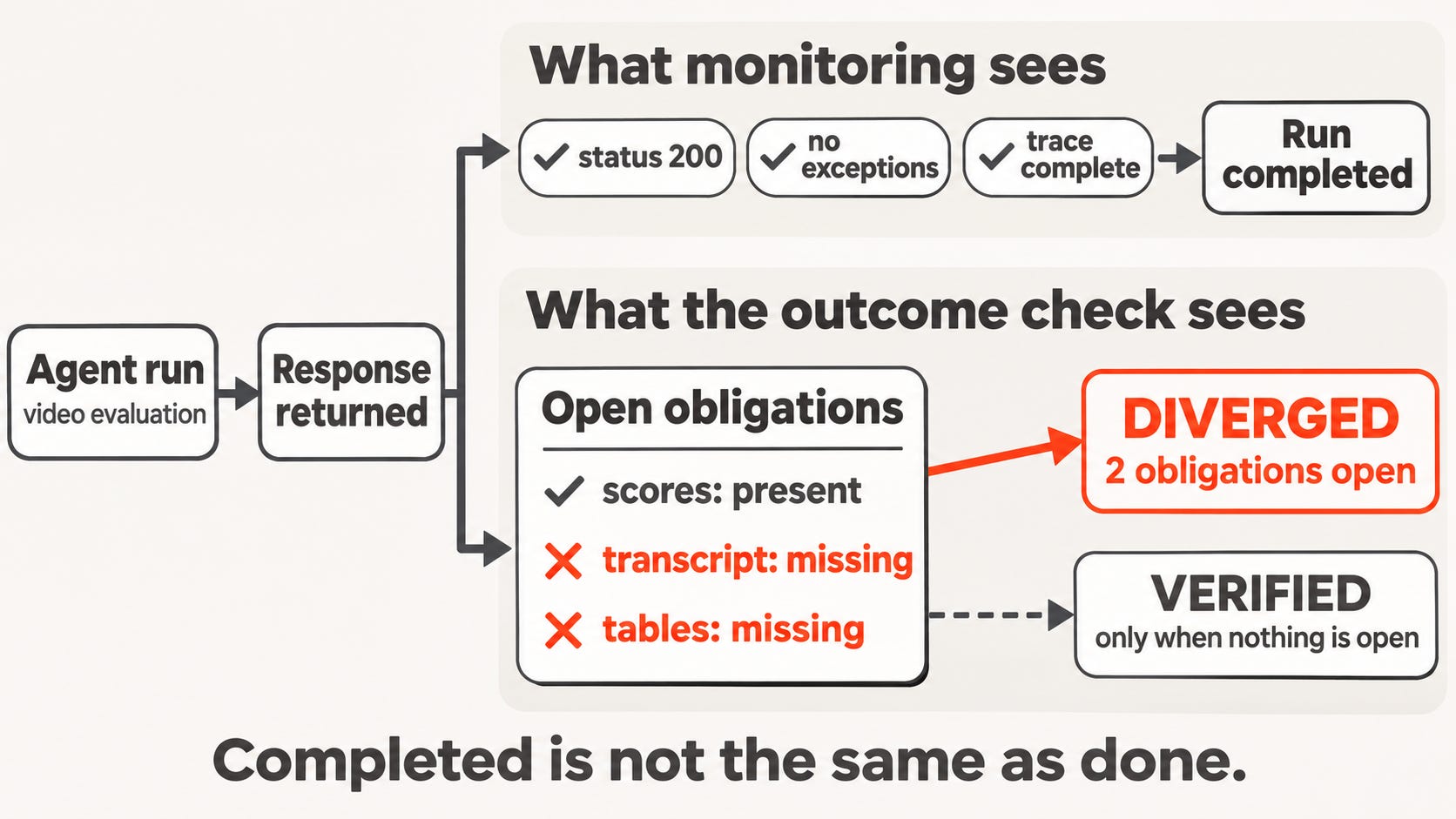
A while back at Binoloop, I was building the video evaluation pipeline for Atlas, our agent platform that grades documents and videos against rubrics. One afternoon, a teammate opened an evaluation to walk through it and stopped scrolling. The scores were there. The feedback was there. The transcript and the tables those scores were supposed to be based on? Gone.
I checked the alerts first. Nothing. Logs were clean, and the status said success. Then I checked the storage bucket, and the transcript JSON was sitting exactly where it should be. The pipeline had produced everything. It just never carried it into the response.
That’s the part that stung. There wasn’t one bad run to point at. Every evaluation looked complete from the outside, and short of opening them one by one, we had no way to tell which ones weren’t. By every signal we monitored, the job had succeeded.
In effect, the system had marked the tray complete after delivering only one of the outputs it owed us.

Green dashboards measure the run, not the result
Simply put, silent success is the gap between “the run completed” and “the outcome happened.” Our monitoring answered the first question perfectly. Status codes, latency, exceptions, traces. All green.
None of it asked whether the transcript was in the response.
Once I started looking, I found the same shape all over our issue tracker:
Missing output: the video evaluation that returned scores without its transcript and tables. Nothing errored, so nothing alerted.
Racing state: document evaluation sometimes started before extraction had finished, then reported “no documents found” for a document that existed. Our first instinct was to add a wait and disable the button. That moves the race. It doesn’t remove it.
Malformed output accepted: for a 4-point rating scale, a confusing prompt made the model return the wrong rubric structure. It parsed well enough to reach production.
Lost handoff: long documents were sometimes only partly extracted and never reached the assessment step at all.
Different pipelines, one root cause. Each step reported its own success, and nobody owned the question “did the user get what they asked for?”
What today’s research gets right about “done”
A paper I covered this week, CarryOn from UNSW Sydney and HKUST (Guangzhou), studies long-horizon agents and lands on a split I wish I’d had earlier. An agent needs two different things from its past: state (what’s done and what’s still open) and evidence (the exact raw values it acts on).
On 168 AppWorld tasks with Claude Sonnet 5, giving the agent its full history solved 43.5% of them. Replacing that history with a small control state plus selected raw evidence solved 79.8%. Same model, same tools. I wrote up the details here.
One field in that control state stuck with me: open, the obligations still outstanding. That was exactly what our video pipeline lacked. The run’s state said “done.” The evidence (the transcript JSON) never arrived. And nothing in the system remembered that “return the transcript” was still open.
Make “done” something you can check
The fix we’re moving to is boring on purpose. Every run declares its obligations up front, and each obligation is checked against the real output, not the agent’s report of it.
from dataclasses import dataclass, field
from typing import Callable

@dataclass
class Obligation:
 name: str
 check: Callable[[dict], bool] # reads the real output

@dataclass
class OutcomeContract:
 obligations: list[Obligation]
 open: list[str] = field(default_factory=list)

 def verify(self, output: dict | None) -> str:
 if output is None:
 return “INDETERMINATE” # result not observable
 self.open = [o.name for o in self.obligations if not o.check(output)]
 return “VERIFIED” if not self.open else “DIVERGED”

video_eval = OutcomeContract([
 Obligation(“scores”, lambda r: bool(r.get(“scores”))),
 Obligation(“transcript”, lambda r: bool(r.get(“transcript”))),
 Obligation(“tables”, lambda r: bool(r.get(“tables”))),
])
A run only counts as a success when the verdict is VERIFIED. DIVERGED names the exact obligations still open, which turns a vague “it looks off” bug report into a specific one. INDETERMINATE blocks downstream work instead of guessing.
The same idea covers the other patterns. Readiness becomes a read-after-write check (“is the extracted document actually queryable?”) instead of a timer. Rubric output gets a strict schema check that rejects the wrong structure instead of passing it on. Retries stay bounded and carry an idempotency key, so a second attempt can’t quietly double-write.
Put the gap on the dashboard
If I could add one number to every agent dashboard, it would be the verified outcome rate: the share of runs where every obligation was checked and met. Put it right next to your success rate.
The gap between those two numbers is your silent success rate. Ours wasn’t zero. Yours probably isn’t either.
Completed is not the same as done.
Five sentences to take with you
Silent success is when an agent run finishes cleanly, returns a confident answer, and still never delivers the outcome the user asked for.
It slips through because most harnesses check whether a run completed, while almost nothing checks whether each promised output actually exists.
In one recent paper, an agent given its full history solved 43.5% of tasks, and the same model with a small “what’s still open” record plus exact evidence solved 79.8%.
The fix is to write every promised output down as an obligation and verify it against the real result before anything gets marked done.
A wait timer, a retry, or an extra log line won’t save you, because none of them knows what “done” was supposed to mean.
References
CarryOn: Learning What to Keep in Context for Long-Horizon LLM Agents: the state-versus-evidence split and the 43.5% vs 79.8% AppWorld result.
Your agent saw its whole history. It scored 36 points lower: my full breakdown of CarryOn on Learn Agentic AI.
EffectMatch: approving outcomes instead of actions, with commit only on an exact match between approved and observed changes.
AppWorld: the benchmark of multi-app agent tasks behind the CarryOn numbers.
What’s the sneakiest “successful” run you’ve caught in your own agents? Leave a comment, I’d love to compare notes.
A few books to take this further
If today’s issue has left you wanting to learn more, I’ve put together five books that can help you move from experimenting with LLMs to building agents of your own.
Building LLM Powered Applications by Valentina Alto covers how to turn language model capabilities into useful software.
Generative AI with LangChain by Ben Auffarth and Leonid Kuligin looks at how LangChain can connect models, data and application workflows.
Building AI Agents with LLMs, RAG, and Knowledge Graphs by Salvatore Raieli and Gabriele Iuculano explores how retrieval and connected knowledge can give agents better information to work with.
Building Agentic AI Systems by Anjanava Biswas and Wrick Talukdar moves into tool use, multi-step tasks and coordinated agent workflows.
30 Agents Every AI Engineer Must Build by Imran Ahmad offers a hands-on way to put those ideas into practice through real agent projects.

You do not need to read all five or follow a set order. Start with the one closest to what you are trying to build and take it from there. I’ve kept the five titles and more together on one page if you would like to explore them.
That’s it for this one. We’ll pick up the conversation next week.
Until then, keep building.
Tanya D’cruz
Editor-in-Chief
One gap in the contract: bool(r.get("transcript")) still passes a half-extracted transcript, which is your lost-handoff case. Checks against the input catch it, like the transcript's last timestamp landing within a few seconds of the video's duration, or extracted page count matching the PDF's page count.