

Editor’s note
As AI makes code easier to produce, a different constraint is becoming harder to ignore: the human attention required to specify, review and trust it.
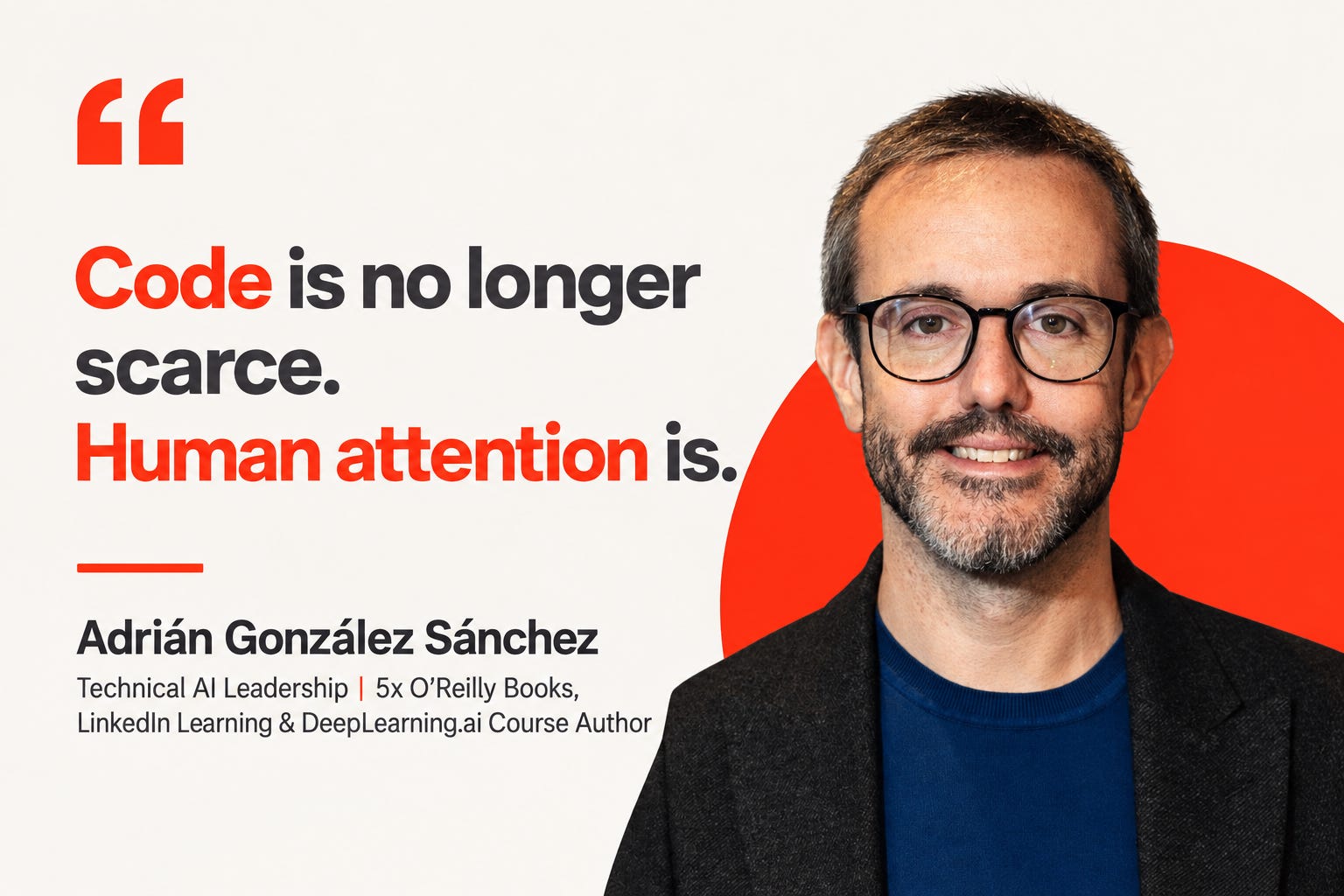
In this issue, Adrián González Sánchez, Technical Product Manager at Microsoft AI and author of Packt’s Generative AI for Leaders Playbook, explains how an AI harness can help teams protect that attention.
But first, here’s a practical 30-minute session from Infisical on giving agents access without exposing credentials.
Agent Vault in Action
Give Agents Access, Not Secrets

Your agent needs credentials to do its job, but a long-lived key stored in its config can end up in logs or get pulled out through prompt injection.
Join Infisical on October 21 at 1 PM ET for a 30-minute live demo of Agent Vault. You’ll see how agents can call APIs without ever seeing the underlying credentials, plus how to limit which services they can reach and cut off their access automatically when a session expires.
We’ll also show how to add these controls to Claude Code, Codex, or your own agent without code changes, and how to trace a request back to the agent that made it when you need to investigate.
I think for the last few years, we have been optimizing the wrong scarcity. AI adoption within software engineering is clearly settled: roughly 90% of developers use AI daily per Google’s 2025 DORA report, and GitHub merges 43 million pull requests a month, up 23% year over year. Regardless of the source, it is clear that code is no longer scarce or even expensive.
But delivery tells another story. The DORA report finds that AI amplifies whatever organizational system (e.g., team composition, collaboration workflows, assets) it lands in rather than fixing it. At the individual level, METR’s randomized trial found experienced developers 19% slower with AI on real tasks, while believing they were 20% faster. And for some strange reason, the industry has prioritized tokenmaxxing and individual per-developer “productivity” (vanity) metrics such as number of PRs enabled by AI, rather than focusing on the overall productivity of the teams, and the actual outcome and additional value generated thanks to AI.
So we can say that the constraint has moved. It is no longer about generating code; it is the processes and collaboration workflows within software engineering teams, and the human attention needed to specify, verify, and decide. And in these times of hyperactivity and multitasking, that attention is limited and is being spent pretty badly. I call this the cognitive attention deficit: the growing gap between what our AI systems produce and what our software teams can responsibly attend to.
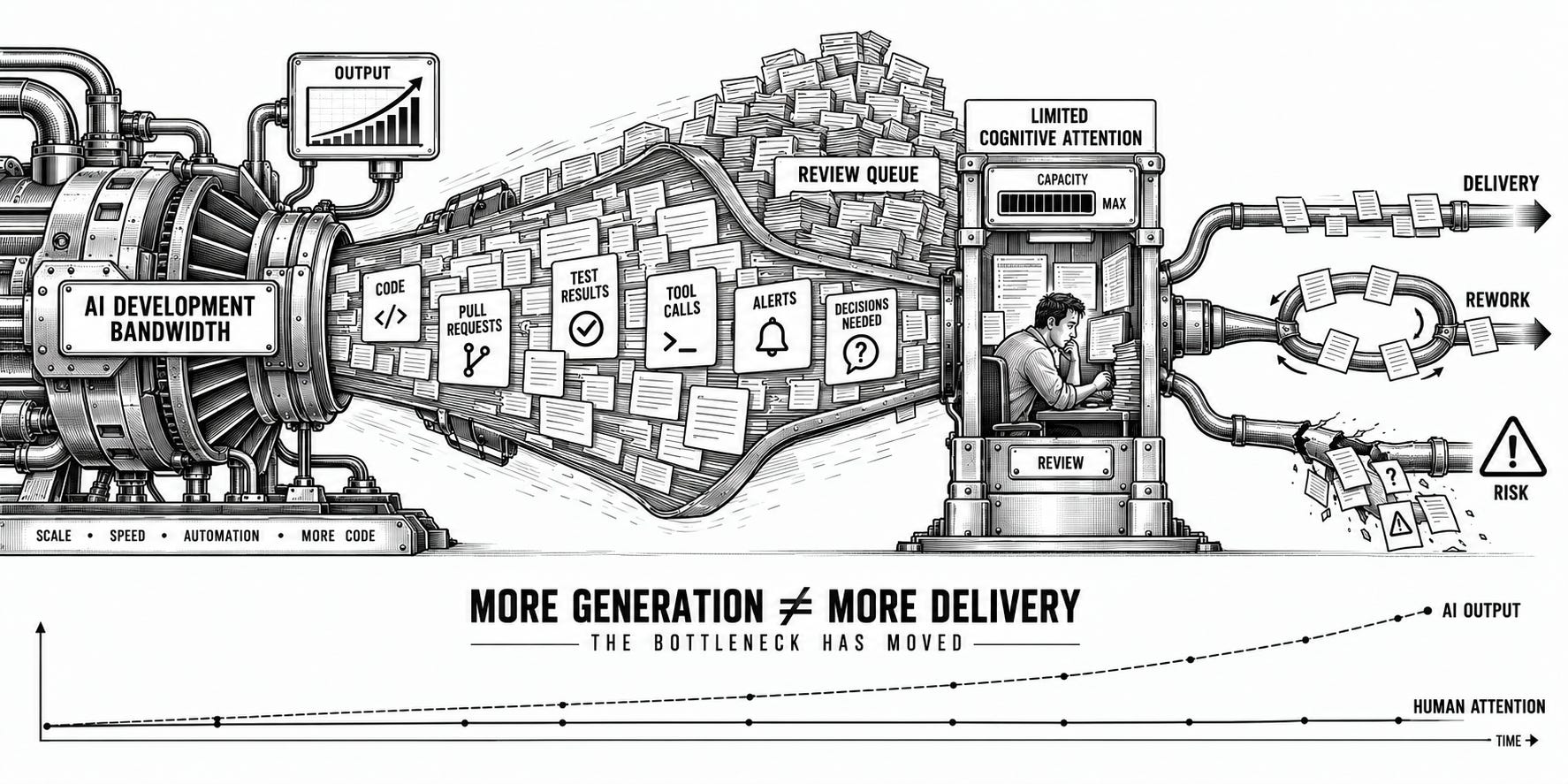
The deficit has multiple answers, but from an engineering perspective, the emerging solution can be what we call the AI harness.
What a harness actually is (in the context of development teams)
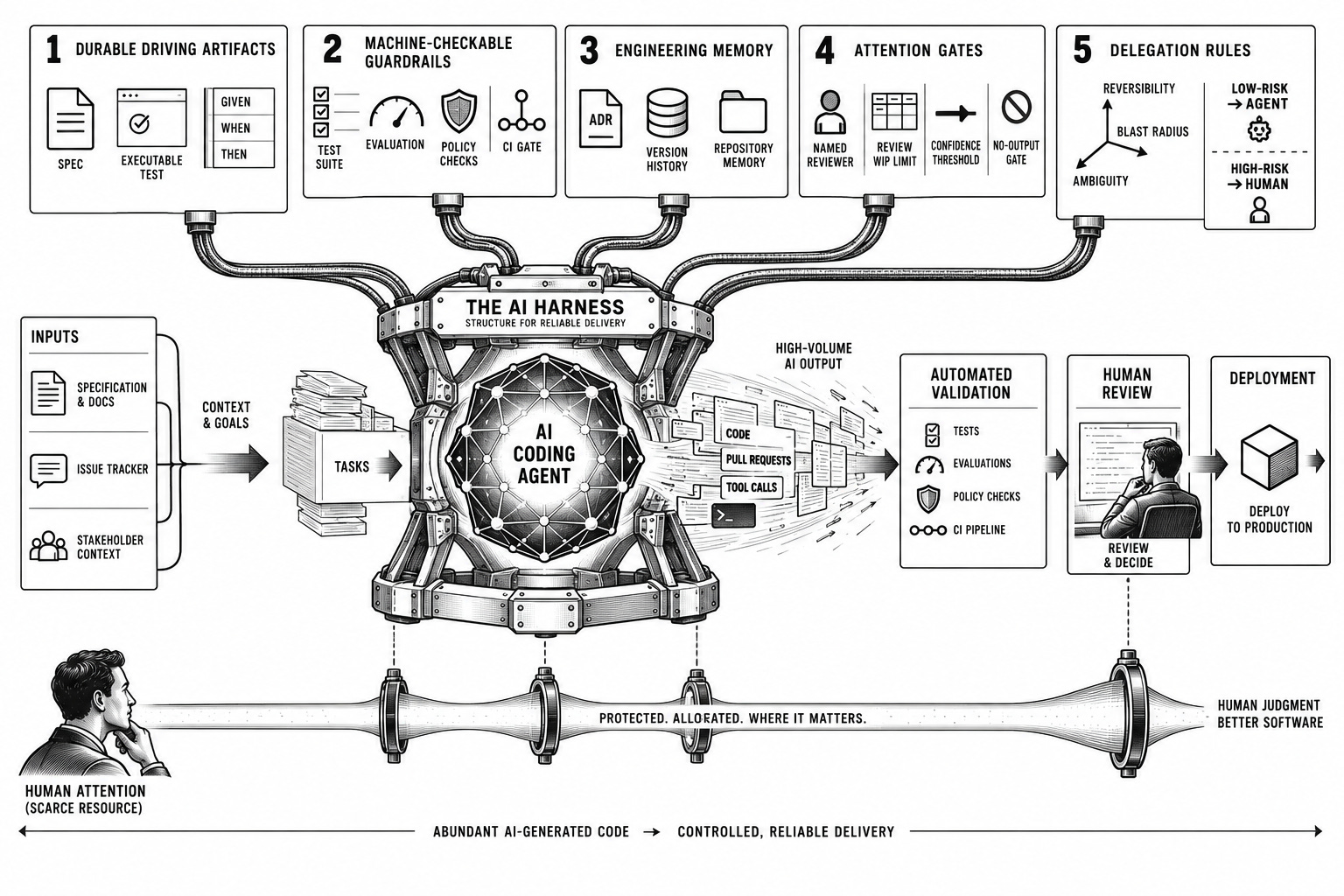
The metaphor is exact: a harness does not make the horse stronger, but it makes its strength usable by directing force, preventing damage, letting the driver watch the road. An AI harness does the same for human attention: not a product you buy, but a set of artifacts and rules built once and reused, so judgment is spent only where judgment is required. Five components, in my experience:
Durable driving artifacts
Intent used to be carried by people. The engineer who wrote the code remembered why. In the case of AI agents with limited memory, intent must live somewhere durable: a co-authored spec for ambiguous and higher-stakes work, executable tests for crisp logic, given-when-then scenarios for user-facing behavior, etc. So basically everything that goes beyond simple and ephemeral prompts, and that can be reviewed, reproduced, or handed to a colleague within the same team.
Machine-checkable guardrails
Without this, “almost right” pieces sail through a tired human review at six in the evening. So here we move verification from tired humans to tireless machines: tests generated after humans define what correct means, evaluation suites, policy checks, or CI gates. Every automated check refunds attention to the questions machines cannot answer, while avoiding the trap of expecting humans to keep the review processes at the same pace as the AI-enabled development.
Engineering memory
When work moves at machine speed, no one holds the whole picture, and decisions get generally made blind. The answer is old-fashioned: decision records, kept current, mandatory in a narrow set of sensitive places rather than aspirational everywhere. The test: if the author leaves and the chat session is gone, does the “why” survive? If not, someone pays attention twice for the same decision.
Attention gates
Three practices, none of which cost money. First, assign a named reviewer when the work begins. An unassigned review queue is not a process; it is merely a hope that someone will take responsibility. Second, set a WIP limit for the review stage. Most teams limit the stages that were bottlenecks before AI while leaving the new constraint, human review, uncapped. And third, explicit confidence thresholds that determine when an agent should produce no output at all. An empty suggestion is cheaper than a plausible but incorrect one.
Delegation rules
The agent harness must clearly define who has decision-making authority. Evaluate each decision using three questions: Is it reversible? What is its potential blast radius? How ambiguous is the specification? If it is reversible, contained, and clearly specified, let the agent decide and stop spending human attention on it. If it is irreversible, far-reaching, or ambiguous, assign the decision in advance to a named person. The costliest failures I have seen were caused not by bad decisions, but by decisions nobody owned.
The traditional process protected scarce code-building capacity, so the gates sat in front of implementation. The harness protects scarce attention, so the gates move with fewer in front of the keyboard, and more around specification, verification, and decisions. Teams that keep old processes while using new AI tools tend to slow the machine and still exhaust the humans (something we are experiencing nowadays, too often); while teams with a proper AI harness run faster because attention is pre-allocated.
There is also a wellbeing argument we should stop calling soft. Review fatigue means people approve what they would have questioned a year ago, leading even to declining confidence in their own judgment. An unmanaged attention deficit is paid in burnout. So we can say that harnesses enable sustainable pace, made structural.
So where do we start?
Well, I don’t have a general answer. But if your review queue grows while releases stay flat, measure three numbers: time to first review, review duration, rework rate. They usually show where attention leaks and bottlenecks appear. Close the leakiest seam first: a WIP limit and reviewer of record if review is drowning, a real spec practice if rework climbs, decision records in your most sensitive directory if the same questions keep returning, one page of delegation rules, etc. But not all five components at once; do it progressively and keep improving your operating system and technical harness.
And remember, every new tool and model release increases the agent's capability and, therefore, its potential impact within the harness. As a result, the value of investing in robust controls, delegation rules, and review processes compounds over time. The winning software engineering teams will not be the ones with the strongest agents; everyone will have those as they progressively become a commodity. They will be the ones who decide deliberately and in advance where their human attention goes and where AI takes care of things.
Catch up with Adrián
Explore Adrián’s new Packt book, Generative AI for Leaders Playbook, connect with him on LinkedIn, subscribe to his Substack, or take one of his DeepLearning.AI courses. He also has a new course on software engineering teamwork coming soon, which is closely connected to the ideas explored in this article.
That’s it for this one. We’ll pick up the conversation next week.
Until then, keep building.
Tanya D’cruz
Editor-in-Chief