

Editor’s note
Apparently, three weeks inside an agent harness only made you want another series. The poll at the end of Part 3 returned a resounding vote for more.
The timing works nicely, however. Earlier this week, we published a conversation with Tanya Dixit, an FDE at Google. Rather than let the subject disappear into the podcast archive, we’re keeping the FDE momentum going and taking the conversation onto the page.
Henry (the same author who took us Inside the Harness) is back to pull the role apart properly. Across four parts, we’ll examine why FDE exists, what it isn’t, where it came from, and who should consider taking it on.
Over the past month, four friends have told me they were considering a career change. One is a front-end developer, another a solutions architect, the third a product manager, and the fourth an algorithm engineer. They come from different backgrounds, generations, and cities, but they all asked me the same question about the same three-letter acronym.
Is FDE worth pursuing?
FDE stands for Forward Deployed Engineer. Two years ago, the term was still confined to Palantir’s orbit. Today, recruiters lead with it, job boards are filling with it, and social media regularly nominates it as one of the AI era’s most valuable new roles.
In May 2026, OpenAI launched the OpenAI Deployment Company with more than $4 billion in initial investment. Its premise was explicit. Embed engineers specialising in frontier-AI deployment inside organisations and help turn model capability into working systems. Anthropic is also recruiting FDEs across the United States and Europe. A title once heard mostly within Palantir circles is becoming an industry category.
In an earlier essay, To Super Individuals, I described the “human engine” as curiosity, self-learning, self-motivation, and hands-on competence reinforcing one another in a closed loop. But those qualities need somewhere to land. If super individuals are the raw material of the AI era’s new division of labour, FDE is one of the clearest job forms to emerge from it.
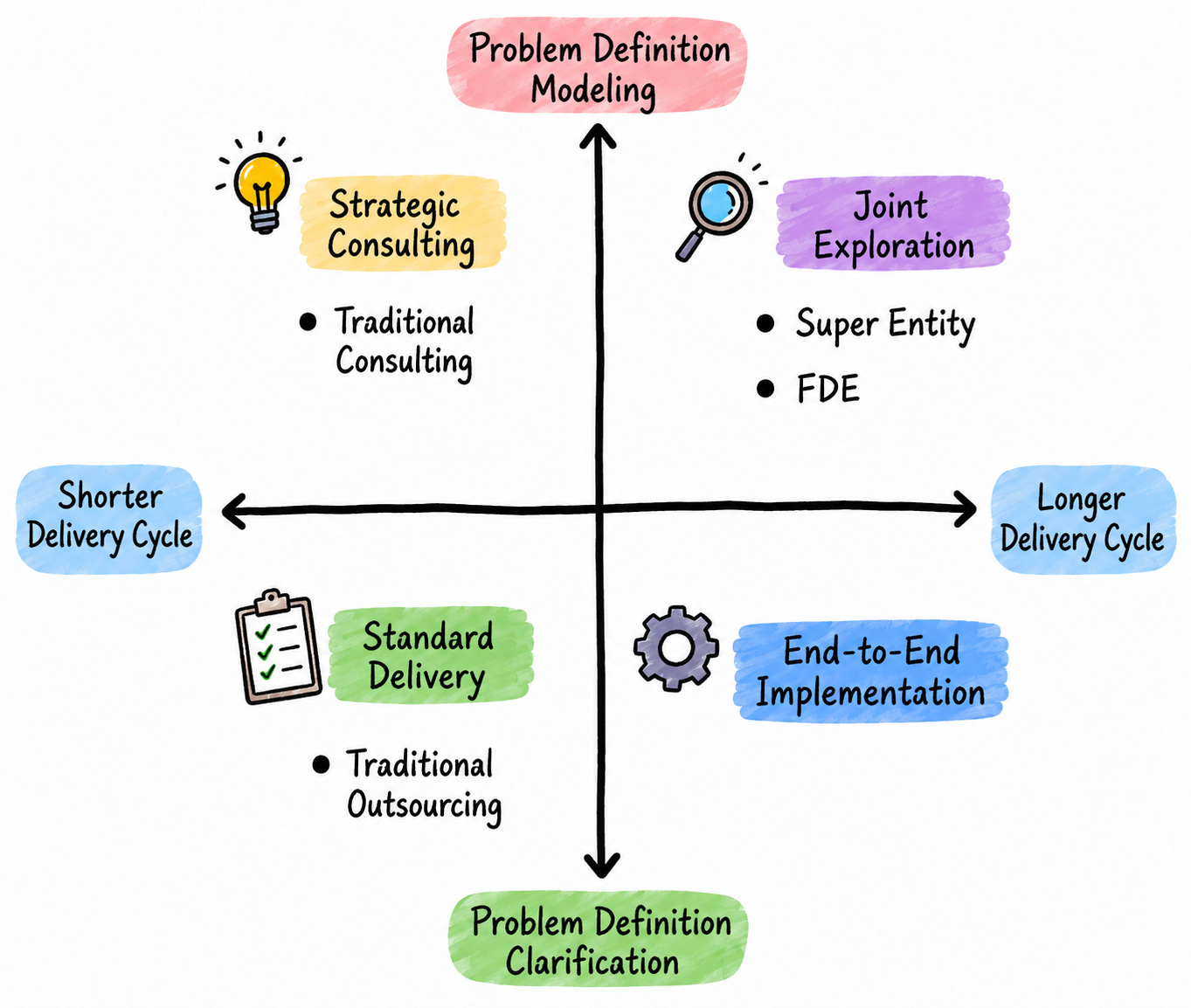
From my perspective, FDE belongs to neither consulting nor outsourcing. It is closer to the “super individual” given a specific organisational position, standing in the gap between model companies and their customers.
For less hype and more engineering, pull up a chair.
But where did the term ‘forward deployed’ come from?
The phrase has military roots. Forward-deployed forces are stationed close to where they may be needed rather than held at a domestic base, allowing them to respond quickly when circumstances change.
Palantir brought the same idea into software. Instead of keeping engineers at headquarters and receiving requirements after they had passed through several layers, it placed them in the field to work directly with customers and take responsibility for the outcome. As one long-serving Palantir FDE describes it, the role is less about delivering predefined technical components and more about solving the customer’s problem alongside them.
It is no coincidence that OpenAI and Anthropic have returned to this model. The technology has changed, but the deployment principle has not. Put engineers close enough to the problem that they can see it clearly.
Across this four-part series, I’ll work through the three questions those conversations kept returning to.
Is FDE just consulting dressed in AI clothing? Where does it diverge from traditional consulting?
Is it a more advanced form of software outsourcing? What separates it from the vendor work many engineers already do?
Would I suit an FDE role? Who thrives in it, and who gets crushed by it?
My view is cautiously optimistic. FDE is gaining momentum, but it is not a universal escape hatch for anyone looking to reinvent their career in AI. Before we hype it, we need to understand what the job asks of people.
Start with OpenAI’s deployment company
If I had to choose one event that marked FDE’s move from specialist jargon into the mainstream, it would be 11 May 2026.
That was the day OpenAI announced the OpenAI Deployment Company, a standalone business unit created to embed Forward Deployed Engineers inside organisations trying to put frontier AI to work. It launched with more than $4 billion in initial investment.
OpenAI also agreed to acquire Tomoro, a UK-based applied AI consultancy. The deal would bring ~150 experienced Forward Deployed Engineers and Deployment Specialists into the new company from day one.
The scale of the hiring is just as revealing. As of September 2026, a search of OpenAI’s careers page returns 25 forward-deployed roles across North America, Europe, Asia and Australia. Alongside general FDE positions are dedicated roles covering healthcare, legal work, government and semiconductors.
This is not a small experimental team. OpenAI is building a global deployment function with industry-specific depth.
Anthropic is making much the same move. Its Applied AI team is recruiting Forward Deployed Engineers to embed directly with strategic customers. Some positions require engineers to spend between 25 and 50 per cent of their time working at client sites.
One example is Anthropic’s partnership with the financial technology company FIS. Anthropic’s Applied AI team and FDEs are embedded within FIS to co-design a Financial Crimes AI Agent. Just as importantly, they are transferring enough knowledge for FIS to build and scale further agents independently.
This is the FDE role in practice. It is not pre-sales architecture, client training, or technical evangelism. FDEs work inside the customer’s environment, alongside the teams who understand the business, and turn a model into something that can survive contact with real data, controls, and workflows.
Put that relationship into a diagram and the three-way structure becomes clearer.
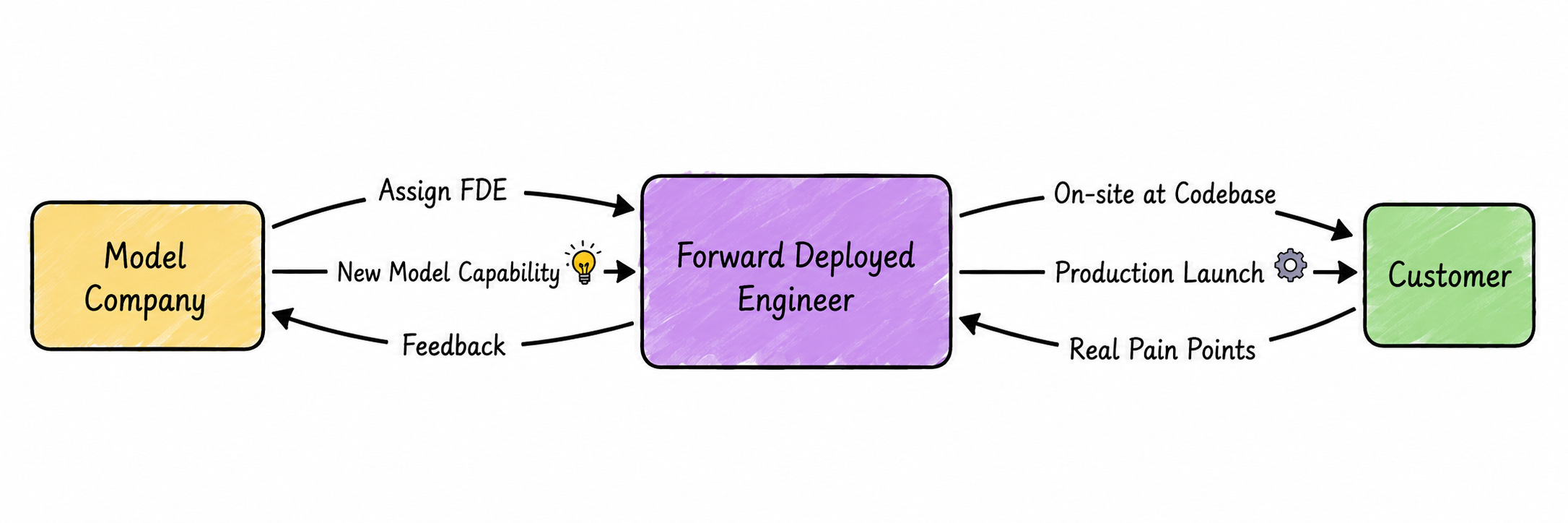
Note that the two most informative lines in this diagram are the feedback loops that FDE transmits to both sides. Towards the client side, FDE does not sell the model as a SaaS; instead, it integrates the client’s data, permissions, compliance requirements, and internal systems into a pipeline capable of running the model. Towards the model provider side, FDE brings the client’s real pain points and failure samples back to the product and research teams to influence the roadmap — a faulty tool calling pattern may well become the next built-in abstraction in the SDK.
This is why FDE has been simultaneously reinstated by two leading model companies in this round, and the reasoning behind it goes far beyond a simple “we also want to follow Palantir’s lead and do consulting”. It serves as a signal acquisition device for model companies: the densest customer pain points on the front line can only be captured when their own personnel are present, as requirements relayed through partners always come with an extra layer of detachment. Anthropic is taking a hybrid approach: on one hand, it operates FDE in-house, and on the other, it builds joint venture deployment networks with consulting firms and PE giants. One leans toward self-operation, the other toward the ecosystem, but their core logic is identical: a model company is no longer just an API provider, but will dispatch engineers to embed in the client’s product team.
The most revealing lines in the diagram are the two feedback loops.
For the customer, an FDE does more than provide access to a model. They connect it to the customer’s data, permissions, compliance controls, and internal systems until it can operate inside a real workflow.
For the model company, the loop runs in reverse. The FDE carries real pain points and failure cases back to the product and research teams. A tool-calling failure that often appears in customer deployments may eventually become a new abstraction built into the SDK.
This is why the return of FDE goes far beyond model companies borrowing Palantir’s consulting playbook. An FDE also acts as a signal acquisition device. The hardest deployment problems are easiest to understand from inside the customer’s workflow. By the time requirements have travelled through several intermediaries, some of that signal has already been lost.
Direct FDEs preserve that feedback loop. Partner networks solve a different problem by extending the model company’s reach. Anthropic combines both approaches, embedding its own engineers while expanding deployment through the Claude Partner Network and a new enterprise AI services company.
The core logic is the same… a model company can no longer stop at providing an API. It must get close enough to the customer’s product team to understand why deployment fails and help make it work.
That explains why FDE exists, but it doesn’t quite explain what kind of work it is.
From the outside, it looks like consulting with an API key… or outsourcing with better branding. In Part 2, we will debug both these assumptions.
That’s it for this one. We’ll pick up the conversation next week.
Until then, keep building.
Tanya D’cruz
Editor-in-Chief
