

Editor’s note
In the last two weeks, we’ve established that FDE is neither consulting in AI clothing nor outsourcing with better branding. This week, Henry traces the role from Palantir into today’s AI companies, then follows it into China.
We picked China because it presents the same basic problem, powerful models that still have to be made useful inside real businesses, but a very different enterprise environment. That makes it a clean test of which parts of the FDE model are fundamental and which are simply American defaults.
Let’s get straight into it!
One origin, two FDE models
Many people assume OpenAI coined the term FDE. It didn’t. The role originated at Palantir, then re-emerged in a different form inside the new generation of AI companies after 2023.
Looking at the two versions side by side makes it easier to see what stayed the same—and what changed.
Let’s start with a timeline.
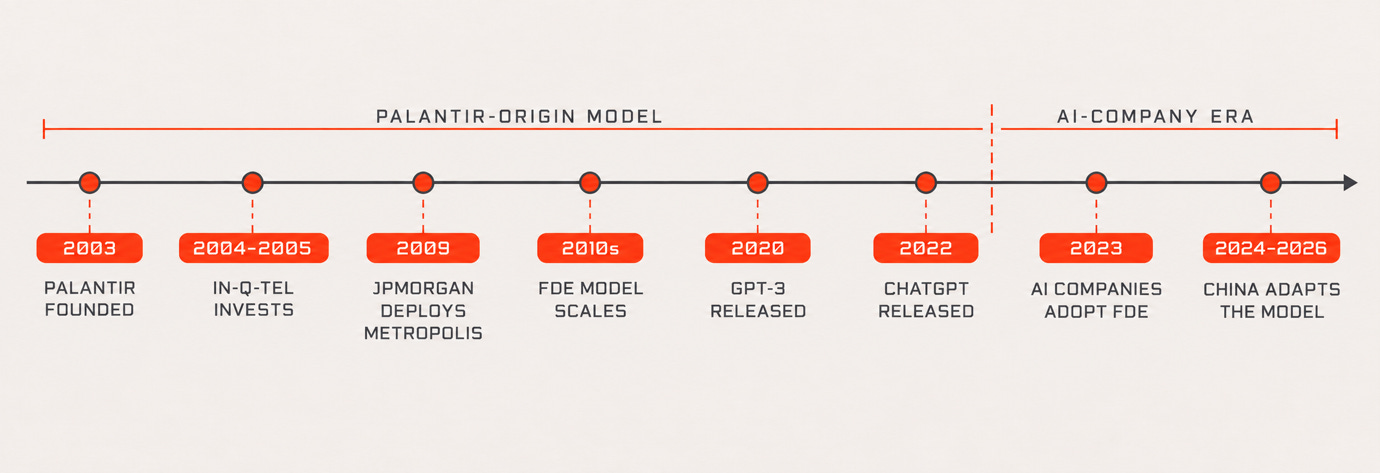
The FDE role began at Palantir, whose early intelligence clients could not simply send a neat list of requirements back to headquarters. Palantir embedded engineers alongside analysts and operational teams so they could see the problem first-hand, build inside the customer environment, and carry what they learned back into the product. By 2009, the same model had entered Palantir’s commercial work.
The history can be reduced to one operating decision. Instead of asking the customer to translate a messy operational problem into a software requirement, put an engineer close enough to solve it with them.
After ChatGPT was released, AI companies encountered the same problem. Access to a powerful model did not give customers a working Product Form. OpenAI, Anthropic, Cohere, Scale AI, and others began building FDE teams to carry use cases from the first demo into production.
The relationship remained the same. Customers were buying more than software. They were buying tools combined with engineers capable of solving their problems.
What changed was the work itself. Palantir’s FDEs focused heavily on data integration, ontology modelling, and permission governance. The new generation works more with prompt design, agent orchestration, tool calling, evaluations, and workflow integration. The former resembles an advanced systems integrator. The latter looks more like a product engineer working beyond the company boundary.
After 2023, Palantir’s original playbook found a new home inside AI companies. But that convergence has largely been American. In China, FDE has followed a different route.
For less hype and more engineering, pull up a chair.
FDE in China: From solution architect to AI implementation engineer
The term FDE has not been around for long in China, but the work itself did not emerge out of thin air. To understand how the role is developing there, we must first recognise its two local foundations, then identify the three ways in which it differs from the US model.
Two local foundations
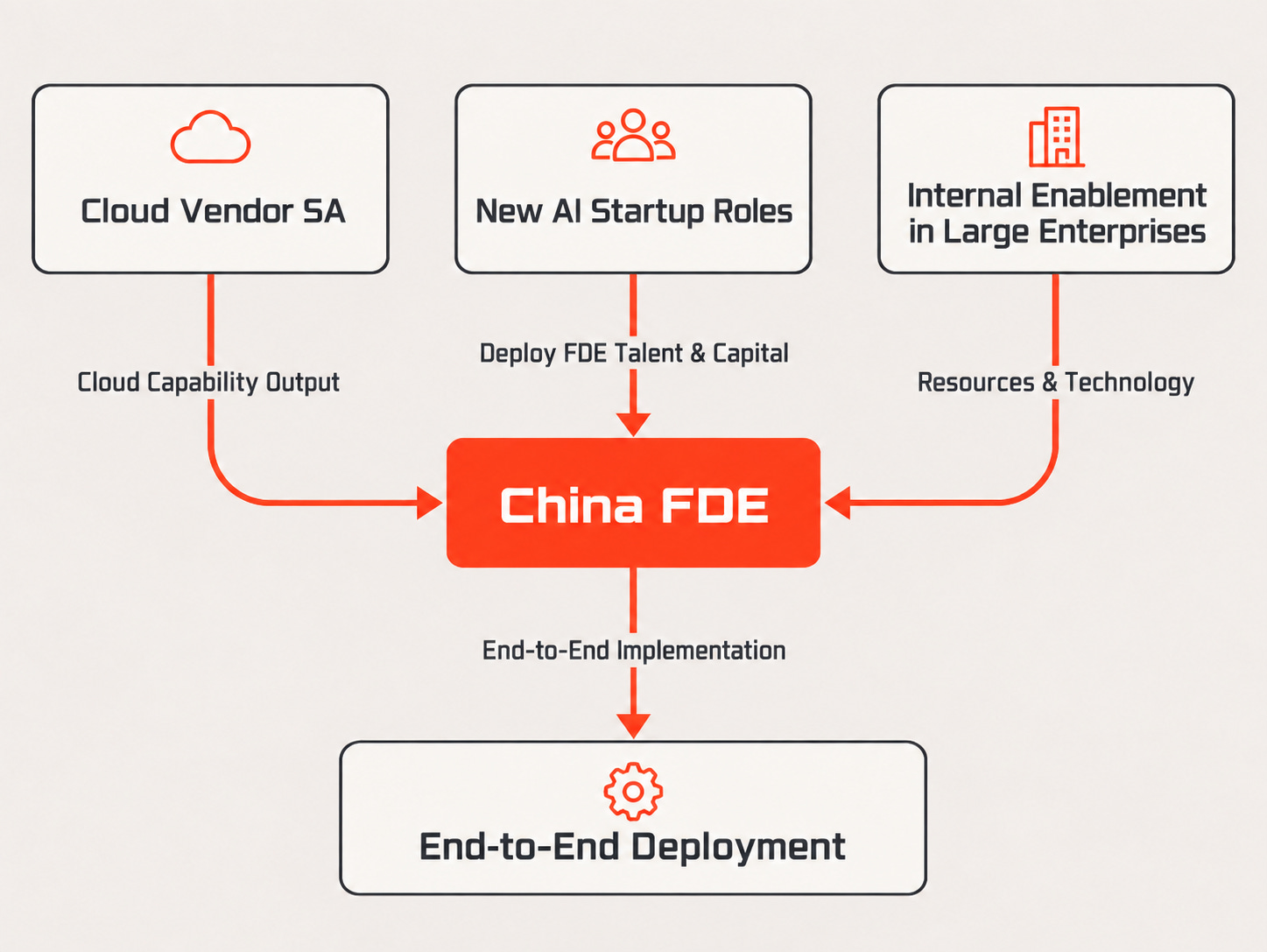
The first foundation was the solution architect at a cloud vendor. Over the past decade, Alibaba Cloud, Tencent Cloud, and Huawei Cloud have built established teams of solution architects responsible for explaining architectures to customers, building POCs, formulating migration plans, and coordinating delivery until launch. Huawei also has a dedicated delivery engineer track responsible for implementing projects in customers’ data centres.
This system already covers much of the work associated with FDE, but its focus remains on pre-sales and deployment. Solution architects do not own end-to-end product iteration. Requirement changes must go through a formal change process, while product or model replacements depend on scheduling from headquarters.
The second foundation is the role now emerging from AI start-ups. MiniMax has advertised an “AI pre-sales solutions expert” position on BOSS Zhipin, while companies and model teams such as Moonshot AI, Zhipu AI, Alibaba’s Tongyi, and Tencent’s Hunyuan are recruiting for similar roles.
The titles vary, but the job descriptions are highly consistent. They involve understanding customer scenarios, creating demos, tuning prompts, implementing RAG, drafting delivery plans, and coordinating with the customer’s engineering team until launch. These roles are the closest thing to a native Chinese FDE.
Three differences in the local terrain
Private deployment and data compliance make a pure API model difficult. Chinese enterprise customers place much greater emphasis than their US counterparts on data residency, control over model deployment, and auditability. In my experience, API calls and prompt work may account for only 30% of an FDE project. The remaining 70% involves moving the model into the customer’s data centre, implementing authentication and permissions, connecting it to the internal data platform, and completing compliance requirements.
Smaller gaps between models push the competition into the engineering layer. In the US, model capability can be a stronger initial differentiator. Among Chinese offerings such as Tongyi, Doubao, Kimi, GLM, and DeepSeek, customers are less likely to choose on model benchmarks alone. Their evaluation criteria therefore fall largely on agent orchestration, RAG retrieval quality, tool integration, and workflow design. What Chinese FDEs compete on is not “how powerful my model is,” but “whether I can actually get this business up and running.”
Enterprise willingness to pay and procurement cycles differ from those in the US. It is difficult to replicate a Palantir-style model built around intensive on-site work and high-value software contracts. Chinese customers’ budgets follow annual procurement plans, and payment tends to be project-based. The FDE business model therefore often takes a hybrid form of subscription + private-deployment licence + project delivery.
A distinctive model: The in-house FDE
AI teams inside many large technology companies have begun serving “internal customers” through an FDE-like model. Alibaba Cloud PAI engineers work directly with teams inside Taobao, while Tencent Hunyuan uses a similar mechanism across WeChat and its advertising business lines.
Job listings with titles such as “industry implementation engineer,” “AI application engineer,” and “intelligent business specialist” are essentially in-house FDEs. They translate the capabilities of the model team end to end into working systems for the business unit.
This offers leaders at large companies another option. Embed several internal FDEs within the business units, get the first demo running, and put the ROI data in front of the business head. That can break down departmental silos faster than ten alignment meetings.
China’s version of FDE is not a direct copy of Palantir’s. Private deployment, enterprise procurement, and in-house AI teams have reshaped the role around local constraints. The title may be imported, but the job is already becoming its own thing.
That tells us how FDE travelled. It does not tell us who should take the job. In Part 4, we turn to the more personal question: who thrives as an FDE and who gets crushed by it?
That’s it for this one. We’ll pick up the conversation next week.
Until then, keep building.
Tanya D’cruz
Editor-in-Chief